
How MemoryFuel Works: Brain Energy Buffers, Six Key Trials and the Evidence Gaps
MemoryFuel's case rests on one well-understood piece of physiology, the creatine and phosphocreatine energy system, plus four supporting nutrients. Here is the mechanism in plain language, the trials that tested it, and an honest account of what remains unproven.
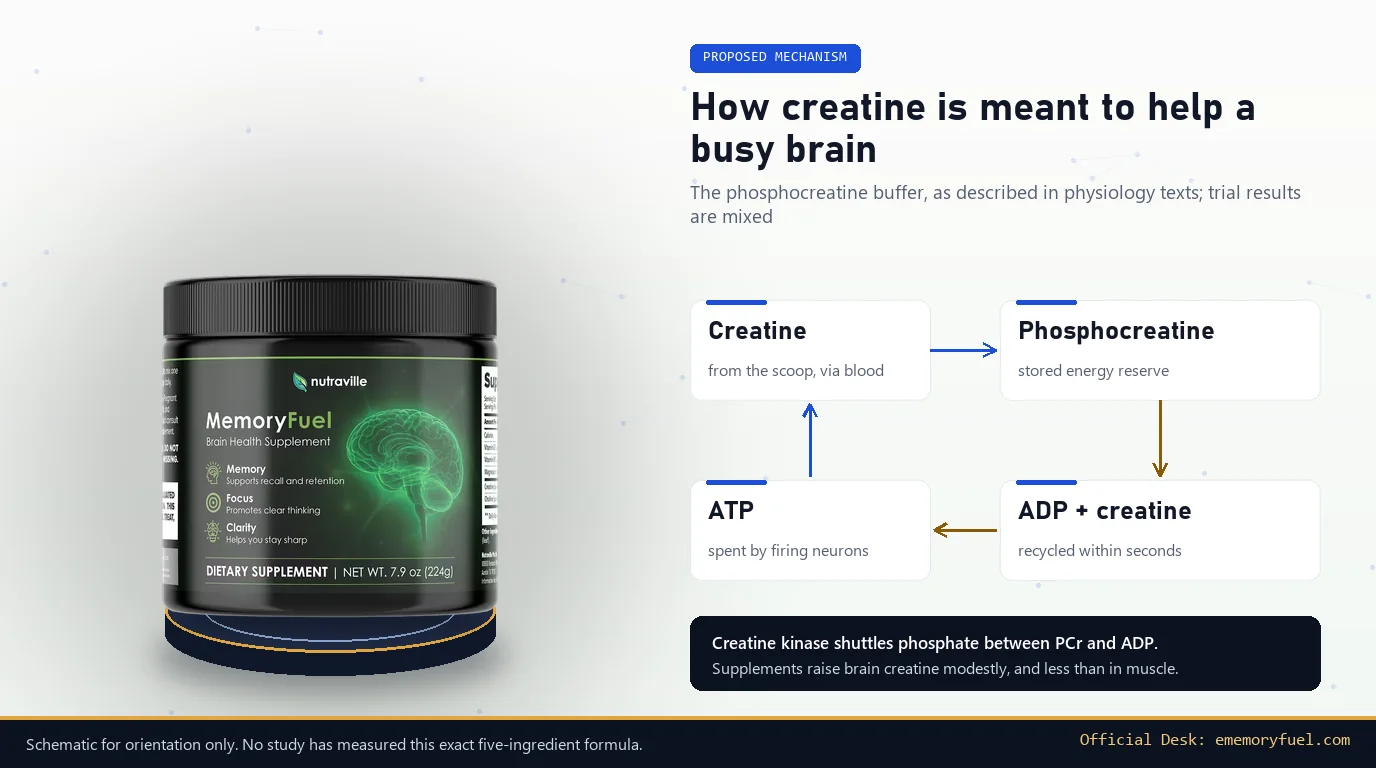
The brain's energy problem
The adult brain is about 2% of body weight but uses roughly a fifth of the body's resting energy. It runs on ATP, the cell's energy currency, and neurons spend ATP at high and fluctuating rates: every action potential, every reset of ion gradients, every packaging of neurotransmitter into vesicles costs energy. Unlike muscle, the brain cannot store much glycogen, so it depends on steady delivery of glucose and oxygen plus fast local buffers that cover sudden spikes in demand.
The fastest of those buffers is the creatine and phosphocreatine system. It does not create energy from nothing; it shuttles energy from the mitochondria, where ATP is made, to the places in the cell where ATP is spent, and it holds a reserve that can regenerate ATP within milliseconds. That is the scientific core of MemoryFuel's pitch, and it is legitimate physiology.[1][2] Where the marketing goes further than the science is in the claim that ordinary forgetfulness comes from an "ATP gap" that a scoop can close. That phrase is advertising, not a diagnosis.
Creatine kinase and the phosphocreatine shuttle
Inside a neuron, the enzyme creatine kinase moves a phosphate group between ATP and creatine. When energy is plentiful, ATP donates phosphate to creatine, making phosphocreatine (PCr). When demand spikes, PCr hands the phosphate back to ADP, rebuilding ATP on the spot. Brain cells carry their own versions of creatine kinase, one in the mitochondria and one in the cytoplasm, which together form a shuttle between the cell's power plants and its work sites.
The brain gets creatine two ways: it makes some itself, and it imports some from the blood through a dedicated transporter at the blood-brain barrier. That transporter is not very generous, which is the main reason supplements raise brain creatine much less than muscle creatine. People born with genetic defects in creatine synthesis or transport have severe intellectual disability, which shows how much the brain relies on the system, but it does not mean a healthy brain is short of creatine.[1]
What a supplement actually changes in the brain
Magnetic resonance spectroscopy lets researchers measure brain creatine without a biopsy. In an early study, 20 g a day of creatine monohydrate for four weeks raised total brain creatine by under 10% on average, with variation between regions and between people.[3] Later reviews put typical increases in the low single digits to around 10%, compared with 20% to 40% in muscle.[1][2]
Two patterns stand out. First, people who start lower, such as vegetarians and possibly older adults, have more room to rise. Second, the clearest functional effects appear when the brain is under stress: sleep deprivation, low oxygen or mental fatigue. In those states demand outpaces supply, and a bigger reserve may matter. In a rested, well-fed young adult the system may already be working comfortably, which is consistent with the null result in that group.[8][6]
For MemoryFuel's 5 g daily dose, the implication is a slow build. Muscle saturation at 3 to 5 g a day takes about four weeks; brain creatine, which rises less and lags behind, needs at least as long. Any noticeable effect, if it comes, belongs to weeks four to ten, not the first afternoon.
What the trials show, in one table
Individual trials are small, used different tests and mostly used higher doses than MemoryFuel. Read them as signals, not proof.
| Study | Who | Creatine dose | What happened |
|---|---|---|---|
| Rae 2003[5] | 45 young vegetarian adults | 5 g/day for 6 weeks | Better working memory (backward digit span) and reasoning |
| McMorris 2006[6] | 19 healthy adults, 24-36 h without sleep | 20 g/day for 7 days | Less decline on some complex tasks and mood |
| McMorris 2007[7] | 32 adults, average age about 76 | 20 g/day for 1 week | Gains on several memory and spatial tasks |
| Rawson 2008[8] | 22 young adults | 0.03 g/kg/day for 6 weeks | No cognitive improvement |
| Benton 2011[9] | 128 young women, vegetarian and omnivore | 20 g/day for 5 days | Memory improved in vegetarians only |
| Gordji-Nejad 2024[10] | 15 adults during one night of sleep deprivation | Single dose of 0.35 g/kg (about 25 g) | Short-term gains in processing and memory for several hours |
The pooled analyses put these together. A 2018 systematic review judged that creatine may improve short-term memory and intelligence or reasoning in healthy people, with inconsistent results for other domains.[11] A 2023 meta-analysis found a small positive effect on memory overall, larger in adults aged roughly 66 to 76.[12] A 2024 meta-analysis of sixteen trials reported effects on memory, attention time and processing speed time, but not on general cognition or executive function.[13] None of these tested MemoryFuel, and none combined creatine with choline, magnesium and vitamins.
About the "2024 Nature study" the order page cites: it is the Gordji-Nejad paper in Scientific Reports, part of the Nature portfolio. It gave a single high dose to sleep-deprived volunteers and measured brain energy metabolites and short-term performance. It is genuinely interesting science, but it does not show that 5 g a day improves everyday memory, and it says nothing about results "within hours" at that dose.[10]
Choline and the acetylcholine pathway
Acetylcholine is made from choline and acetyl groups inside cholinergic neurons, the cells hit hardest in Alzheimer's disease. That connection is why choline appears in so many memory formulas, and why the main class of Alzheimer's drugs works by slowing acetylcholine breakdown.
The supplement logic has limits, though. Neurons recycle much of their choline, the brain draws it from a large membrane pool, and blood choline crosses into the brain through a transporter that does not simply scale with intake. Observational data link higher dietary choline with better memory scores, but supplement trials in healthy adults have been mixed.[14][15] At the scoop's modest dose, choline is best seen as a nutritional top-up for the many people who eat less than the adequate intake, not as a cognitive booster.
Magnesium, vitamin D3 and B12: supporting roles
Magnesium binds ATP inside cells (most cellular ATP exists as a magnesium-ATP complex) and regulates NMDA receptors involved in synaptic plasticity. In the formula's story it is the cofactor that lets the energy system work. Clinically, the best evidence is a possible effect on subjective anxiety in people with low intake.[16]
Vitamin D3 is included because vitamin D receptors are present in the brain and low levels are common. A large randomized trial at the same 2,000 IU dose did not slow cognitive decline in older adults, so its role here is general health insurance.[17]
Vitamin B12 protects myelin and keeps homocysteine in check. Deficiency causes real memory problems that resolve with treatment; in people with normal levels, extra B12 does not improve cognition.[18]
The synergy claim, examined
MemoryFuel's design treats the five actives as a system: creatine for energy buffering, magnesium for the enzymes that handle ATP, choline for neurotransmitter supply, D3 and B12 to close common gaps. The logic is coherent. Each piece connects to a real pathway, and none works against another.
What is missing is evidence that the combination outperforms creatine alone. No trial has tested it. The claim on the order page that the extra ingredients "work synergistically with creatine to maximize brain ATP production" is a hypothesis presented as a finding. A fair summary: if MemoryFuel helps your memory, creatine is the most likely reason, and the other four ingredients mainly matter if you were short of them.
Who is most likely to notice a difference
Putting the mechanism and the trials together gives a fairly clear profile of the people for whom creatine, and therefore MemoryFuel, has the best odds. It is worth reading before you buy, because it may save you a refund trip.
- People who eat little or no meat and fish. Their baseline creatine is lower, and two of the positive trials were in vegetarians.[5][9]
- Adults in their late sixties and older. The 2023 meta-analysis found the memory effect larger in this age band, and one positive trial had an average age near 76.[12][7]
- People who often run short on sleep. Shift workers, new parents and frequent travelers are the closest everyday match to the sleep-deprivation studies.[6][10]
- Young, well-rested omnivores. The cleanest trial in this group found nothing at a maintenance-style dose.[8]
- Anyone expecting a stimulant feeling. Creatine does not act like caffeine; there is no rush, and no crash either.
Individual response also varies for reasons nobody can predict in advance, such as how much creatine a person's transporter lets into the brain. That is the practical argument for testing yourself with a simple recall log, like the one on our homepage, rather than relying on anyone's testimonial.
What no powder can do
The biggest levers for long-term brain health are well documented and mostly free. The 2024 Lancet Commission estimates that nearly half of dementia cases worldwide are linked to fourteen modifiable risk factors, including hearing loss, high blood pressure, physical inactivity, diabetes, smoking, social isolation, high LDL cholesterol and untreated vision loss.[19] A year of aerobic walking enlarged the hippocampus and improved spatial memory in older adults in a well-known trial.[20] Sleep consolidates memory every night.
The National Institute on Aging draws the line that matters: mild, occasional forgetfulness is part of normal aging, while memory loss that disrupts daily life is not, and needs a medical evaluation.[21] MemoryFuel belongs, at most, in the first category.
Questions readers send about this
How does MemoryFuel work in the brain?
Mainly through creatine, which the brain uses as phosphocreatine, a quick-release energy reserve that rebuilds ATP during spikes in demand. Supplements raise brain creatine modestly over weeks. Choline, magnesium, D3 and B12 support related pathways and fill nutritional gaps.
Does MemoryFuel really work?
It may help a little, particularly for older adults, vegetarians and people under sleep pressure, based on creatine research. The formula itself has never been tested, and trials in rested young adults found no benefit. Expect modest, gradual effects at most.
Is the ATP gap a real condition?
No. "ATP gap" is a marketing phrase. Brain energy metabolism is real physiology, and it changes with aging and disease, but ordinary forgetfulness is not diagnosed as an ATP shortage, and no test for it exists.
Why does creatine work better when sleep deprived?
Sleep loss strains brain energy supply, so the phosphocreatine reserve has more work to do. Several trials found creatine blunted some performance drops during sleep deprivation, which is not the same as improving memory in well-rested people.
How long before MemoryFuel starts working?
Plan on four to ten weeks. At 5 g a day, muscle creatine saturates in about a month and brain creatine rises more slowly. Effects in the first few hours are unlikely at this dose.
Sources behind this page
Every link opens the original abstract or agency page. Most trials gave creatine or a single nutrient on its own, often at other doses; none tested the MemoryFuel blend.
- 1Dolan E, Gualano B, Rawson ES. Beyond muscle: the effects of creatine supplementation on brain creatine, cognitive processing, and traumatic brain injury. Eur J Sport Sci. 2019;19(1):1-14. pubmed.ncbi.nlm.nih.gov/30086660/
- 2Roschel H, Gualano B, Ostojic SM, Rawson ES. Creatine supplementation and brain health. Nutrients. 2021;13(2):586. pubmed.ncbi.nlm.nih.gov/33578876/
- 3Dechent P, Pouwels PJ, Wilken B, Hanefeld F, Frahm J. Increase of total creatine in human brain after oral supplementation of creatine-monohydrate. Am J Physiol. 1999;277(3):R698-R704. pubmed.ncbi.nlm.nih.gov/10484486/
- 4Kreider RB, Kalman DS, Antonio J, et al. International Society of Sports Nutrition position stand: safety and efficacy of creatine supplementation in exercise, sport, and medicine. J Int Soc Sports Nutr. 2017;14:18. pubmed.ncbi.nlm.nih.gov/28615996/
- 5Rae C, Digney AL, McEwan SR, Bates TC. Oral creatine monohydrate supplementation improves brain performance: a double-blind, placebo-controlled, cross-over trial. Proc Biol Sci. 2003;270(1529):2147-2150. pubmed.ncbi.nlm.nih.gov/14561278/
- 6McMorris T, Harris RC, Swain J, et al. Effect of creatine supplementation and sleep deprivation, with mild exercise, on cognitive and psychomotor performance, mood state, and plasma concentrations of catecholamines and cortisol. Psychopharmacology (Berl). 2006;185(1):93-103. pubmed.ncbi.nlm.nih.gov/16416332/
- 7McMorris T, Mielcarz G, Harris RC, Swain JP, Howard A. Creatine supplementation and cognitive performance in elderly individuals. Neuropsychol Dev Cogn B Aging Neuropsychol Cogn. 2007;14(5):517-528. pubmed.ncbi.nlm.nih.gov/17828627/
- 8Rawson ES, Lieberman HR, Walsh TM, Zuber SM, Harhart JM, Matthews TC. Creatine supplementation does not improve cognitive function in young adults. Physiol Behav. 2008;95(1-2):130-134. pubmed.ncbi.nlm.nih.gov/18579168/
- 9Benton D, Donohoe R. The influence of creatine supplementation on the cognitive functioning of vegetarians and omnivores. Br J Nutr. 2011;105(7):1100-1105. pubmed.ncbi.nlm.nih.gov/21118604/
- 10Gordji-Nejad A, Matusch A, Kleedörfer S, et al. Single dose creatine improves cognitive performance and induces changes in cerebral high energy phosphates during sleep deprivation. Sci Rep. 2024;14(1):4937. pubmed.ncbi.nlm.nih.gov/38418482/
- 11Avgerinos KI, Spyrou N, Bougioukas KI, Kapogiannis D. Effects of creatine supplementation on cognitive function of healthy individuals: a systematic review of randomized controlled trials. Exp Gerontol. 2018;108:166-173. pubmed.ncbi.nlm.nih.gov/29704637/
- 12Prokopidis K, Giannos P, Triantafyllidis KK, et al. Effects of creatine supplementation on memory in healthy individuals: a systematic review and meta-analysis of randomized controlled trials. Nutr Rev. 2023;81(4):416-427. pubmed.ncbi.nlm.nih.gov/35984306/
- 13Xu C, Bi S, Zhang W, Luo L. The effects of creatine supplementation on cognitive function in adults: a systematic review and meta-analysis. Front Nutr. 2024;11:1424972. pubmed.ncbi.nlm.nih.gov/39070254/
- 14Poly C, Massaro JM, Seshadri S, et al. The relation of dietary choline to cognitive performance and white-matter hyperintensity in the Framingham Offspring Cohort. Am J Clin Nutr. 2011;94(6):1584-1591. pubmed.ncbi.nlm.nih.gov/22071706/
- 15NIH Office of Dietary Supplements. Choline: Fact Sheet for Health Professionals. ods.od.nih.gov/factsheets/Choline-HealthProfessional/
- 16Boyle NB, Lawton C, Dye L. The effects of magnesium supplementation on subjective anxiety and stress: a systematic review. Nutrients. 2017;9(5):429. pubmed.ncbi.nlm.nih.gov/28445426/
- 17Kang JH, Vyas CM, Okereke OI, et al. Effect of vitamin D on cognitive decline: results from two ancillary studies of the VITAL randomized trial. Sci Rep. 2021;11(1):23253. pubmed.ncbi.nlm.nih.gov/34853363/
- 18Markun S, Gravestock I, Jäger L, Rosemann T, Pichierri G, Burgstaller JM. Effects of vitamin B12 supplementation on cognitive function, depressive symptoms, and fatigue: a systematic review, meta-analysis, and meta-regression. Nutrients. 2021;13(3):923. pubmed.ncbi.nlm.nih.gov/33809274/
- 19Livingston G, Huntley J, Liu KY, et al. Dementia prevention, intervention, and care: 2024 report of the Lancet standing Commission. Lancet. 2024;404(10452):572-628. pubmed.ncbi.nlm.nih.gov/39096926/
- 20Erickson KI, Voss MW, Prakash RS, et al. Exercise training increases size of hippocampus and improves memory. Proc Natl Acad Sci U S A. 2011;108(7):3017-3022. pubmed.ncbi.nlm.nih.gov/21282661/
- 21National Institute on Aging. Memory Problems, Forgetfulness, and Aging. www.nia.nih.gov/health/memory-loss-and-forgetfulness/memory-problems-forgetfulness-and-aging
Run a fair 90-day MemoryFuel trial
Checkout happens on the maker's ClickBank page. Mix one scoop a day exactly as printed, write down a simple recall score on day one, keep the receipt email, and if nothing has moved by about day 75, email the helpdesk while the 90-day window is still open.