
MemoryFuel Ingredients: A Formulation Desk Weighs Every Gram in the Scoop
Five declared actives, three inactive ingredients and no proprietary blend. This page takes each one in turn: what it is, why that chemical form, what the dose means against the research, and where the label leaves a question open.
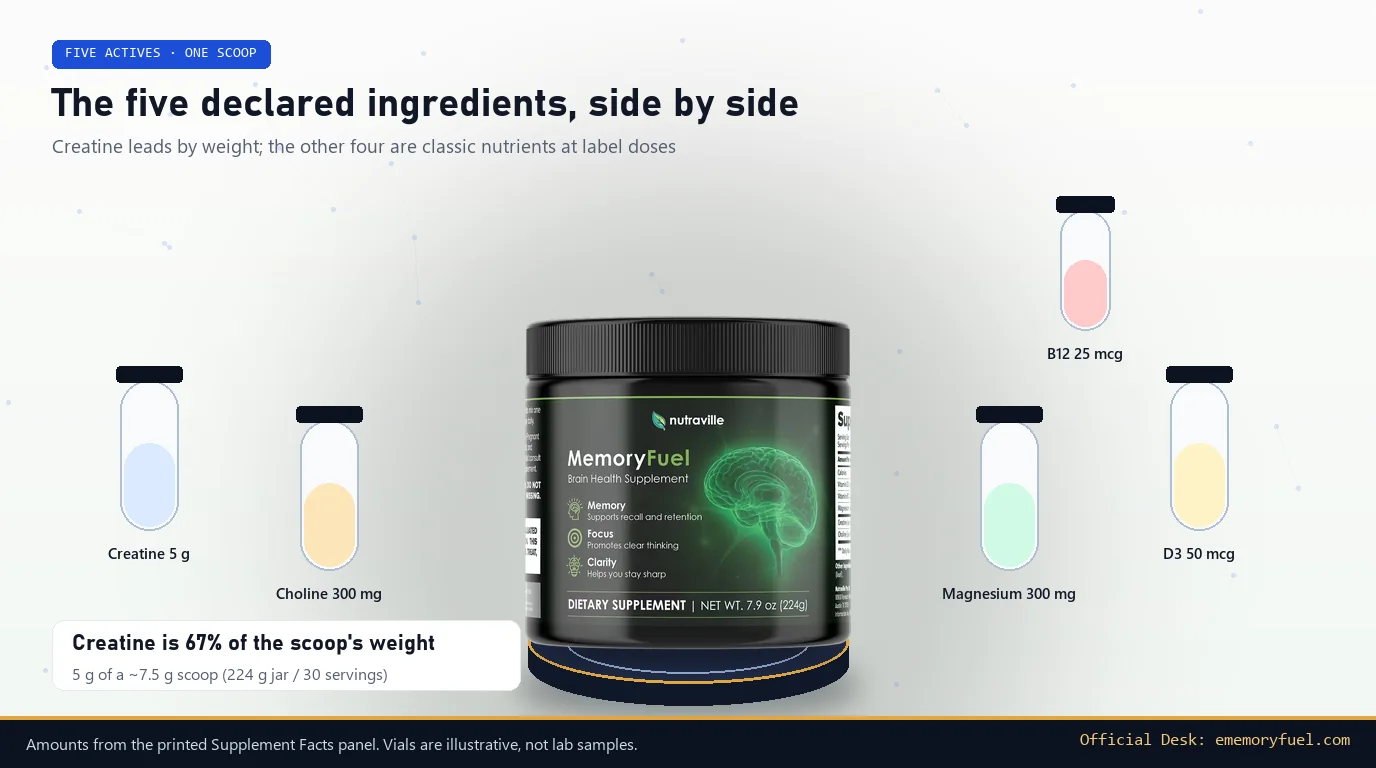
How one 7.5 g scoop is divided
A formulation desk starts where a chemist would: with the weight budget. The MemoryFuel jar is labeled 7.9 oz, or 224 g, for 30 servings, so each level scoop should weigh about 7.47 g. Here is how the declared ingredients fill that space, using standard molecular weights for the salt forms on the label.
| Ingredient (label form) | Label amount | Estimated raw weight in the scoop | Share of scoop |
|---|---|---|---|
| Creatine monohydrate | 5,000 mg | 5.0 g (the label states the monohydrate) | about 67% |
| Magnesium glycinate | 300 mg elemental | 1.5 to 2.1 g, depending on the chelate's magnesium content | 20 to 28% |
| dl-Choline bitartrate | 300 mg | 0.3 g if the figure is the salt; 0.73 g if it is choline itself | 4 to 10% |
| Vitamin D3, vitamin B12 | 50 mcg, 25 mcg | trace (usually on a carrier powder) | under 1% |
| Natural flavors, silicon dioxide, stevia | not stated | whatever remains | small |
The arithmetic is tight. Creatine plus magnesium glycinate alone already account for 6.5 to 7.1 g, which leaves little more than half a gram for choline, two vitamins, flavor, an anticaking agent and sweetener. That is good news in one sense: the powder is almost entirely active material rather than filler. It also explains two practical points. A heaped scoop meaningfully raises your creatine and magnesium dose, and a scant one cuts it, so leveling matters. And the narrow margin is one more reason to suspect the choline line refers to the bitartrate salt rather than to choline itself, because 0.73 g of salt would push the scoop over its own weight.
None of this can be confirmed without a lab assay, and the maker has not published one. Treat the table as a plausibility check that the label hangs together, not as a measurement.
Creatine monohydrate: 5,000 mg
What it is. Creatine is a small nitrogen-containing compound the body makes from three amino acids (arginine, glycine and methionine), mostly in the kidneys and liver, and also absorbs from meat and fish. An average adult carries roughly 120 g of it, about 95% in skeletal muscle, and turns over around 2 g a day, half replaced by diet and half by the body's own synthesis.[2][3] The brain holds a small fraction but uses it constantly.
Why the monohydrate form. Creatine monohydrate is creatine bound to one water molecule. It is the form behind almost every safety and efficacy study, and a review of newer forms, including creatine ethyl ester, buffered creatine and creatine hydrochloride, found none with better evidence and some, like the ethyl ester, that break down to creatinine faster.[1] From a formulator's point of view, choosing monohydrate is the right call, and MemoryFuel makes it.
What quality looks like. Industrial creatine is synthesized from sarcosine and cyanamide. Well-made monohydrate is more than 99% pure; the impurities worth testing for are creatinine, dicyandiamide and dihydrotriazine, plus heavy metals. The label does not name a branded raw material or a purity grade, which is common, but it means you are relying on the maker's supplier checks under federal manufacturing rules.
What the research says for memory. Three systematic reviews define the evidence. A 2018 review of six randomized trials in healthy people reported possible improvements in short-term memory and intelligence or reasoning tasks, with considerable inconsistency.[5] A 2023 meta-analysis of ten trials pooled a small overall memory benefit, larger in older adults.[6] A 2024 meta-analysis of sixteen trials found significant effects on memory, attention time and processing speed time, but not on overall cognitive function or executive function.[7] The common thread: small, real-looking effects that vary by population and test.
Dose context. Five grams a day is the standard maintenance dose. It raises muscle stores to saturation over about four weeks without a loading phase. Brain creatine increases less, by single-digit percentages in spectroscopy studies that used 20 g a day.[8]
Safety snapshot. Healthy adults have taken creatine at this dose for years in studies without harm to kidney or liver function; transient water retention is the most consistent side effect.[3][4] Creatinine on blood tests may read higher; see the side effects page.
Choline: 300 mg as dl-choline bitartrate
What it is. Choline is an essential nutrient the body uses to make acetylcholine, a neurotransmitter for memory and muscle control, and phosphatidylcholine, a major component of cell membranes. The liver makes some, but not enough, which is why an adequate intake exists: 550 mg a day for men and 425 mg for women, with a tolerable upper limit of 3,500 mg.[9]
The salt form. Choline bitartrate pairs choline with tartaric acid. It is the most economical choline source and is about 41% choline by weight. The "dl" refers to the tartrate part being a mix of mirror-image forms; the choline itself is identical either way. Pricier forms such as alpha-GPC and citicoline are marketed as more brain-targeted, and MemoryFuel does not use them.
The label puzzle. Under FDA labeling rules, choline now has a Daily Value of 550 mg, so a panel declaring 300 mg of choline would normally print 55% DV.[22] MemoryFuel's panel instead marks choline with a double asterisk ("DV not established"), the treatment reserved for ingredients without a Daily Value. The likeliest reading is that 300 mg is the weight of the bitartrate compound, which would deliver about 123 mg of choline. We have asked readers to check this with the maker; until it is clarified, plan as if you are getting the lower figure.
What the research says. Most Americans eat less choline than recommended, mainly because eggs, liver and other organ meats have fallen out of favor.[10] In the Framingham Offspring cohort, people with higher dietary choline scored better on verbal and visual memory, an association that does not prove a supplement would help.[11] Gut bacteria convert choline into TMA and then TMAO; a 2016 study tied higher TMAO to platelet reactivity, and choline bitartrate raised TMAO in its human arm.[12] At one scoop the dose is modest, but people with heart disease may prefer to get choline from food.
Food comparison. One large egg supplies roughly 147 mg of choline, so the scoop's realistic contribution (about 123 to 300 mg) sits between one and two eggs.
Magnesium: 300 mg elemental, as glycinate
What it is. Magnesium is a mineral cofactor for more than 300 enzyme systems, including every reaction that uses ATP, which is the formula's link to the creatine energy story. It also helps regulate NMDA receptors involved in learning.[13]
The form. Magnesium glycinate (often sold as bisglycinate) bonds magnesium to the amino acid glycine. It is well absorbed and gentler on the bowel than magnesium oxide or citrate, which is why it is popular for evening use and sensitive stomachs. Pure bisglycinate is about 14% magnesium by weight; buffered chelates run higher. Either way, 300 mg of elemental magnesium requires a lot of powder, which is why this line is the second-heaviest in the scoop.
Dose context. The panel prints this line as 71% of the Daily Value. The RDA is 400 to 420 mg for men and 310 to 320 mg for women. The tolerable upper limit for magnesium from supplements (not food) is 350 mg a day, mostly to avoid diarrhea. One scoop sits at 300 mg, close to that line, so do not stack it with another magnesium supplement or a magnesium-based laxative or antacid without advice.[13]
What the research says. There is no direct memory trial for magnesium glycinate in healthy adults. A systematic review found suggestive evidence that magnesium may help subjective anxiety in anxiety-prone people, with low study quality.[14] The form marketed specifically for the brain, magnesium L-threonate, is not used here.
Who should check first. People with kidney failure, who cannot clear magnesium normally, and anyone on tetracycline or quinolone antibiotics, bisphosphonates or certain thyroid medicines, which magnesium can bind in the gut.
Vitamin D3: 50 mcg (2,000 IU)
What it is. Cholecalciferol, the form the skin makes in sunlight and the form most supplements use. Vitamin D receptors are present in brain tissue, which is the usual justification for including it in a cognitive formula.
Dose context. The RDA is 15 mcg (600 IU) for adults up to 70 and 20 mcg (800 IU) above 70; the Daily Value is 20 mcg, so 50 mcg is 250% DV. The adult upper limit is 100 mcg (4,000 IU), so one scoop is half of it.[15] If you already take a multivitamin with 25 mcg or a separate D3 capsule of 50 mcg, add the numbers before you add the powder.
What the research says. This is the ingredient where the best trial is most humbling. Two ancillary studies of VITAL, a large randomized trial, gave older adults 2,000 IU of vitamin D3 a day, exactly one scoop's amount, for two to three years and found no slowing of cognitive decline compared with placebo.[16] The vitamin is still worthwhile for people who are low; it just should not be counted on for memory.
Practical tip. A blood test for 25-hydroxyvitamin D tells you whether this line matters for you. Fat-soluble vitamins absorb better with food, so taking the scoop with breakfast is a reasonable habit.
Vitamin B12: 25 mcg as cyanocobalamin
What it is. B12 is needed to make myelin, the insulation around nerve fibers, and to recycle homocysteine. Deficiency causes a genuine, reversible form of memory trouble, along with numbness and anemia.[17]
The form. The jar prints cyanocobalamin, the stable synthetic form used in most fortified foods and many clinical studies. The body converts it to the active forms, methylcobalamin and adenosylcobalamin. The maker's homepage describes methylcobalamin instead; for nearly everyone the difference is not clinically meaningful, but the mismatch is worth noting because the label is the legal document.
Dose context. The RDA is 2.4 mcg and the Daily Value 2.4 mcg, which is why the panel prints 1042%. The body's intrinsic-factor pathway absorbs only about 1.5 to 2 mcg from a single dose, with roughly 1% of the rest absorbed passively, so a 25 mcg serving delivers a couple of micrograms. That is enough to maintain status in most people with normal absorption.[17]
What the research says. A 2021 meta-analysis concluded that B12 supplementation does not improve cognitive function, depressive symptoms or fatigue in people without advanced neurological disorders or established deficiency.[18] The people who benefit most are those at risk of low levels: long-term metformin users, people on acid-suppressing drugs, strict vegans and many adults over 60.[19]
The base: flavors, silica, stevia, and what is missing
Natural flavors provide the taste. The label does not say which, which is legal and normal; if you have a specific flavor allergy, ask the maker. Silicon dioxide is an anticaking agent permitted at up to 2% of a food's weight; it keeps hygroscopic powders like creatine from clumping.[20] Stevia leaf extract sweetens with essentially no calories; highly purified steviol glycosides are used widely in the U.S. food supply.[21]
Just as useful is what the panel leaves out. There is no L-theanine, despite the order page listing it. No caffeine, no green tea or guarana, no bacopa, ginkgo or lion's mane. No sugar, no sugar alcohols, no artificial colors. No proprietary blend hiding undisclosed amounts. For a memory product in 2026 that is an unusually clean list, and it makes MemoryFuel easy to combine with coffee or to discuss with a pharmacist.
MemoryFuel vs. buying the five ingredients separately
Because every amount is printed, you can rebuild the formula from single-ingredient products. A fair comparison looks like this.
| Ingredient | MemoryFuel scoop | Separate equivalent | Practical note |
|---|---|---|---|
| Creatine monohydrate | 5 g | 1 rounded teaspoon of plain powder | Unflavored creatine is cheap and tasteless in juice |
| Magnesium glycinate | 300 mg elemental | 2 to 3 capsules of a glycinate product | Check whether the bottle states elemental magnesium |
| Choline bitartrate | 300 mg (form unclear) | 1 capsule, or one or two eggs | Food choline is the simplest route |
| Vitamin D3 | 2,000 IU | 1 softgel | Often already in a multivitamin |
| Vitamin B12 | 25 mcg | 1 small tablet, or a multivitamin | Many multivitamins carry 6 to 25 mcg |
Assembled separately, the materials cost a fraction of $1.63 to $2.63 a day, but you trade one drink for a spoonful plus four or five pills, and you lose the 90-day refund. The value of MemoryFuel is convenience, flavor and a single habit. Whether that is worth the premium is a personal call; we simply want it to be an informed one. Our pricing page breaks the numbers down further.
Questions readers send about this
Does MemoryFuel contain L-theanine?
No. The printed Supplement Facts panel lists creatine, choline, magnesium, vitamin D3 and vitamin B12 only. L-theanine appears on the maker's order page but not on the jar, and the label is what you actually receive.
Is the creatine in MemoryFuel monohydrate?
Yes. The label specifies creatine as creatine monohydrate, 5,000 mg per scoop. That is the form used in nearly all creatine research and generally considered the reference standard.
How much choline does one scoop really provide?
The label says 300 mg as dl-choline bitartrate. If that number is the salt's weight, which the double asterisk suggests, the actual choline is about 123 mg. If it is the choline itself, it is 300 mg. Ask the maker to confirm before you count it toward your intake.
Is MemoryFuel vegan?
The label lists no animal-derived ingredients: creatine monohydrate is synthesized, and the vitamins and minerals are standard synthetic forms. The maker does not carry a vegan certification, so strict vegans may want to confirm the D3 source, which is often lanolin-derived.
Can I take MemoryFuel with a multivitamin?
Usually yes, but add up vitamin D and magnesium. One scoop plus a typical multivitamin can bring vitamin D to around 3,000 IU and magnesium past the 350 mg supplemental limit, which is where loose stools start.
Sources behind this page
Every link opens the original abstract or agency page. Most trials gave creatine or a single nutrient on its own, often at other doses; none tested the MemoryFuel blend.
- 1Jäger R, Purpura M, Shao A, Inoue T, Kreider RB. Analysis of the efficacy, safety, and regulatory status of novel forms of creatine. Amino Acids. 2011;40(5):1369-1383. pubmed.ncbi.nlm.nih.gov/21424716/
- 2NIH Office of Dietary Supplements. Dietary Supplements for Exercise and Athletic Performance: Fact Sheet for Health Professionals (creatine section). ods.od.nih.gov/factsheets/ExerciseAndAthleticPerformance-HealthProfessional/
- 3Kreider RB, Kalman DS, Antonio J, et al. International Society of Sports Nutrition position stand: safety and efficacy of creatine supplementation in exercise, sport, and medicine. J Int Soc Sports Nutr. 2017;14:18. pubmed.ncbi.nlm.nih.gov/28615996/
- 4Antonio J, Candow DG, Forbes SC, et al. Common questions and misconceptions about creatine supplementation: what does the scientific evidence really show? J Int Soc Sports Nutr. 2021;18(1):13. pubmed.ncbi.nlm.nih.gov/33557850/
- 5Avgerinos KI, Spyrou N, Bougioukas KI, Kapogiannis D. Effects of creatine supplementation on cognitive function of healthy individuals: a systematic review of randomized controlled trials. Exp Gerontol. 2018;108:166-173. pubmed.ncbi.nlm.nih.gov/29704637/
- 6Prokopidis K, Giannos P, Triantafyllidis KK, et al. Effects of creatine supplementation on memory in healthy individuals: a systematic review and meta-analysis of randomized controlled trials. Nutr Rev. 2023;81(4):416-427. pubmed.ncbi.nlm.nih.gov/35984306/
- 7Xu C, Bi S, Zhang W, Luo L. The effects of creatine supplementation on cognitive function in adults: a systematic review and meta-analysis. Front Nutr. 2024;11:1424972. pubmed.ncbi.nlm.nih.gov/39070254/
- 8Dechent P, Pouwels PJ, Wilken B, Hanefeld F, Frahm J. Increase of total creatine in human brain after oral supplementation of creatine-monohydrate. Am J Physiol. 1999;277(3):R698-R704. pubmed.ncbi.nlm.nih.gov/10484486/
- 9NIH Office of Dietary Supplements. Choline: Fact Sheet for Health Professionals. ods.od.nih.gov/factsheets/Choline-HealthProfessional/
- 10Wallace TC, Blusztajn JK, Caudill MA, et al. Choline: the underconsumed and underappreciated essential nutrient. Nutr Today. 2018;53(6):240-253. pubmed.ncbi.nlm.nih.gov/30853718/
- 11Poly C, Massaro JM, Seshadri S, et al. The relation of dietary choline to cognitive performance and white-matter hyperintensity in the Framingham Offspring Cohort. Am J Clin Nutr. 2011;94(6):1584-1591. pubmed.ncbi.nlm.nih.gov/22071706/
- 12Zhu W, Gregory JC, Org E, et al. Gut microbial metabolite TMAO enhances platelet hyperreactivity and thrombosis risk. Cell. 2016;165(1):111-124. pubmed.ncbi.nlm.nih.gov/26972052/
- 13NIH Office of Dietary Supplements. Magnesium: Fact Sheet for Health Professionals. ods.od.nih.gov/factsheets/Magnesium-HealthProfessional/
- 14Boyle NB, Lawton C, Dye L. The effects of magnesium supplementation on subjective anxiety and stress: a systematic review. Nutrients. 2017;9(5):429. pubmed.ncbi.nlm.nih.gov/28445426/
- 15NIH Office of Dietary Supplements. Vitamin D: Fact Sheet for Health Professionals. ods.od.nih.gov/factsheets/VitaminD-HealthProfessional/
- 16Kang JH, Vyas CM, Okereke OI, et al. Effect of vitamin D on cognitive decline: results from two ancillary studies of the VITAL randomized trial. Sci Rep. 2021;11(1):23253. pubmed.ncbi.nlm.nih.gov/34853363/
- 17NIH Office of Dietary Supplements. Vitamin B12: Fact Sheet for Health Professionals. ods.od.nih.gov/factsheets/VitaminB12-HealthProfessional/
- 18Markun S, Gravestock I, Jäger L, Rosemann T, Pichierri G, Burgstaller JM. Effects of vitamin B12 supplementation on cognitive function, depressive symptoms, and fatigue: a systematic review, meta-analysis, and meta-regression. Nutrients. 2021;13(3):923. pubmed.ncbi.nlm.nih.gov/33809274/
- 19Aroda VR, Edelstein SL, Goldberg RB, et al. Long-term metformin use and vitamin B12 deficiency in the Diabetes Prevention Program Outcomes Study. J Clin Endocrinol Metab. 2016;101(4):1754-1761. pubmed.ncbi.nlm.nih.gov/26900641/
- 20Electronic Code of Federal Regulations. 21 CFR 172.480: Silicon dioxide. www.ecfr.gov/current/title-21/chapter-I/subchapter-B/part-172/subpart-E/section-172.480
- 21U.S. Food and Drug Administration. Aspartame and Other Sweeteners in Food (high-intensity sweeteners, including steviol glycosides). www.fda.gov/food/food-additives-petitions/aspartame-and-other-sweeteners-food
- 22U.S. Food and Drug Administration. Daily Value on the Nutrition and Supplement Facts Labels. www.fda.gov/food/nutrition-facts-label/daily-value-nutrition-and-supplement-facts-labels
Run a fair 90-day MemoryFuel trial
Checkout happens on the maker's ClickBank page. Mix one scoop a day exactly as printed, write down a simple recall score on day one, keep the receipt email, and if nothing has moved by about day 75, email the helpdesk while the 90-day window is still open.